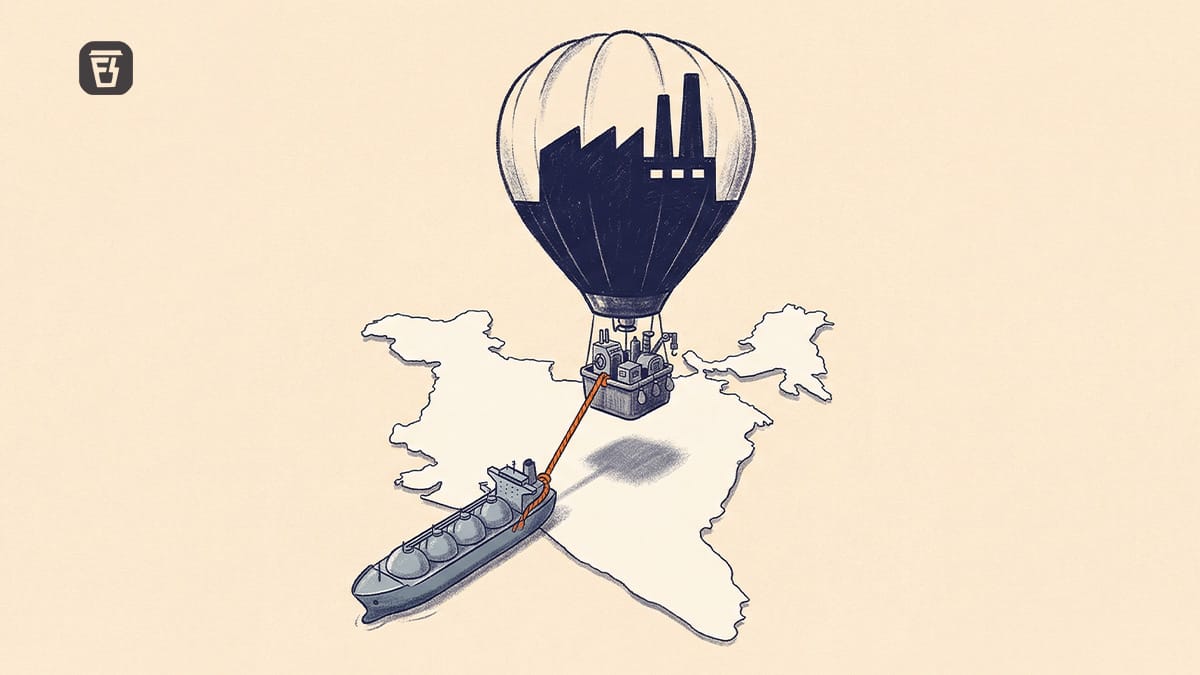
In today’s Finshots, we tell you why the spike in LNG shipping costs matter for India.
The Story
For decades, companies believed that geography no longer mattered. Factories could sit thousands of kilometres away from customers because global trade made the world feel small. A product could be manufactured in Asia, assembled somewhere else, and sold in Europe or America without transport costs significantly affecting the price.
But that assumption only holds when shipping is cheap. When shipping becomes expensive, distance suddenly matters again.
And last week, the shipping rates for LNG (Liquefied Natural Gas) carriers surged by more than 650% within just a few days, spiking to approximately $300,000 per day. Thanks to the ongoing Middle East conflict. That may sound like a niche-industry headline, but it highlights something much bigger — behind almost every product that crosses borders lies a vast, largely invisible logistics system.
For decades, this system worked so efficiently that companies stopped worrying about geography. A smartphone could be assembled in China, shipped across oceans, and sold in Europe at freight costs that would not significantly affect its price.
Cheap and reliable shipping made distance almost irrelevant. And as a result, over 80% of today’s global trade moves by sea, carried by container ships, bulk carriers, tankers, and specialised vessels such as LNG carriers.
Yet, despite how central shipping is to global trade, the industry itself is remarkably unstable. Shipping rates can remain subdued for years and then surge dramatically within weeks when supply chains are disrupted. A sudden shortage of vessels, geopolitical tensions, or even a change in trade routes can send freight prices soaring almost overnight.
In fact, shipping companies often make their biggest profits during periods of global disruption. When conflicts break out or major shipping routes become unsafe, vessels are forced to take longer routes. As a result, the vessel is at sea longer, burning more fuel, and unavailable for new business. So during such moments, the very instability that disrupts global trade can become extraordinarily profitable for them.
Let’s understand this with examples. Below is a chart of the Shanghai Containerized Freight Index (SCFI). It tracks the weekly spot rates for containerized cargo departing from Shanghai to 15 major global ports. One could say that it is the de facto index for shipping prices worldwide.
If you look closely, the biggest spikes in shipping prices rarely coincide with economic booms. They tend to coincide with global crises. It spiked from 2020 to 2022, when economies worldwide were unstable due to the COVID-19 pandemic and the Russo-Ukrainian war. Then, from late 2022 to 2023, when there was no major disruption, prices cooled down significantly.
Sidebar: This is one of the reasons the Indian Government changed the baseline to measure GDP growth from 2012 to 2022. You can read about it here.
Then, in October 2023, the Israel-Palestine war and the Red Sea crisis began, which slowly pushed up the index once again.
So, when a ship or a container’s availability reduces, or routes become longer due to geopolitical tensions, freight costs can multiply overnight. For energy-importing countries like India, that matters a lot more.
Let’s take the recent LNG cargo surge, for instance. LNG shipping is an unusually tight market. There are only around 820 specialised LNG carriers in the world, compared to over 50,000 merchant ships. So, when even a small portion of them is tied up, freight prices can explode, and this is exactly what happened last week.

And for countries that import large amounts of energy from overseas, these fluctuations have direct economic consequences.
India, for instance, is one of the world’s largest importers of liquefied natural gas. In fact, a significant portion of India’s LNG imports comes from the Middle East, particularly from countries like Qatar and the UAE. Much of this supply travels through the Strait of Hormuz, one of the world’s most critical energy chokepoints. Even if Indian cargo ships can safely pass through the strait during periods of tension, a regional conflict can still disrupt production, delay shipments, increase insurance premiums, and tighten the availability of LNG carriers. In such situations, the cost of transporting energy often rises sharply long before the physical supply of gas actually declines.
So, when shipping costs surge, the delivered price of that gas increases regardless of whether the underlying commodity price has changed.
This matters because LNG is deeply embedded in several sectors of India’s economy. It fuels power plants, feeds fertiliser production, and supports industrial processes across multiple industries. When the cost of importing LNG rises unexpectedly, those costs eventually trickle down to you and me. And over time, this starts to increase inflation.
Another unusual feature of shipping markets emerges during periods of extreme volatility. Ships stop behaving purely as transport vehicles and start functioning as floating storage facilities. When freight rates rise or commodity prices fluctuate, traders may keep cargoes at sea temporarily, waiting for better market conditions. The vessel effectively becomes a warehouse on water, and the ocean turns into one of the world’s most expensive storage spaces.
Episodes like the current spike also reveal a broader structural shift in global trade. Rising shipping costs tend to hurt long-distance trade routes more than regional ones. If transporting goods from East Asia to Europe suddenly becomes much more expensive, companies begin to reconsider where factories should be located. Supply chains gradually move closer to end markets to reduce transportation risk.
Now, in theory, this kind of shift could benefit India.
Because geographically, the country sits at a crossroads between Europe, the Middle East, and Southeast Asia. That location offers advantages for trade if companies seek alternatives to long transcontinental shipping routes.
However, geography alone does not determine competitiveness. Port efficiency, logistics infrastructure, and shipping capacity play an equally important role. Sure, we have improved our logistics networks in recent years. But port turnaround times, cargo-handling efficiency, and fleet capacity still lag behind those of our East-Asian peers, such as Singapore and China.
And this is precisely where the competitive race begins.
So, if this shipping volatility becomes more common while India’s logistical bottlenecks remain unresolved, the advantage of geography may not translate into real economic gains. Manufacturers will skip India and choose locations where goods can move more quickly through ports and supply chains.
Shipping rarely captures public attention because it normally functions in the background. Yet, the entire global economy relies on an enormous maritime system that most consumers never see. Episodes like this reveal how central that system is to modern economic life.
At the end of the day, shipping influences energy security, industrial competitiveness, and ultimately the prices households pay for goods. For countries like India, where imported energy plays an important role and supply chains stretch across continents, shifts in freight markets carry consequences far beyond the shipping industry.
Understanding the economics of shipping, therefore, matters more than it appears. When freight markets move dramatically, the effects rarely stay confined to ports. They often trickle down through the entire economy, as we just saw with India.
Until next time…
If this story helped you better understand how global shipping works, feel free to share it with your friends, family, or even strangers on WhatsApp, LinkedIn, and X.
How Strong Is Your Financial Plan?
You’ve likely ticked off mutual funds, savings, and maybe even a side hustle. But if Life Insurance isn’t a part of it, your financial pyramid isn’t as secure as you think.
Life insurance is the crucial base that holds all your wealth together. It ensures that your family stays financially protected when something unpredictable happens.
If you’re unsure where to begin, Ditto’s IRDAI-Certified insurance advisors can help. Book a FREE consultation and get honest, unbiased advice.


