(Bloomberg) — Circle Internet Group Inc. (CRCL) and Stripe Inc. (STRI.PVT) are racing to build payments systems for a world that doesn’t exist yet — one where autonomous AI agents transact millions of times a day, settling in stablecoins instead of swiping credit cards.
Two weeks ago, a Citrini Research scenario imagining AI agents routing around card network fees sent Visa Inc., Mastercard Inc. and American Express Co. shares tumbling as much as 5% in a single session. The selloff faded. The disruption thesis didn’t.
Most Read from Bloomberg
Instead, the idea migrated from a speculative Substack post into earnings calls, and accelerated enthusiasm around product launches and blockchain buildouts.
On its Feb. 25 earnings call, Circle Chief Executive Officer Jeremy Allaire argued that stablecoins could become the native currency of machine-to-machine commerce.
“We’re building a new internet financial system, and I think we’re very optimistic that Circle can play a really key role in this convergence between AI and stablecoins and blockchain,” Allaire said.
The stablecoin industry is now positioning agentic payments, high-frequency, low-value transactions between software agents, as a use case to justify the entire infrastructure buildout.
Investors have piled into both companies, though not solely for the agentic vision. Circle shares surged after a blowout earnings report, and Stripe recently notched a $159 billion valuation driven by $1.9 trillion in payment volume. The agentic bet is layered on top of businesses already growing without it.
The pitch for stablecoins has always been cross-border, faster and cheaper than legacy rails. Domestically, the case is harder to make. Agentic payments offer a way around that problem: a use case where the technology’s advantages over cards aren’t incremental but structural. That gap has left the industry searching for its next growth narrative, and AI agents are fast becoming a key part of that story.
In a separate interview after the earnings call, Allaire drew a distinction between consumer-facing AI commerce and what he sees as the bigger opportunity.
“The problem to solve is not how does an agent buy something on Amazon, I think those problems can be solved in more simplistic ways, which is your AI having a safe way to use your credential with a confirmation from you,” Allaire said. “The real opportunity is all of the things that AIs need to consume from each other.”
Allaire described a future in which AI agents increasingly consume services from one another. A legal skills agent, for instance, fielding requests from external agents acting on behalf of businesses that deployed them. An agent pulling data or making a simple information request might be charged only cents, making traditional card payments costly given their fixed fees and percentage-based pricing.
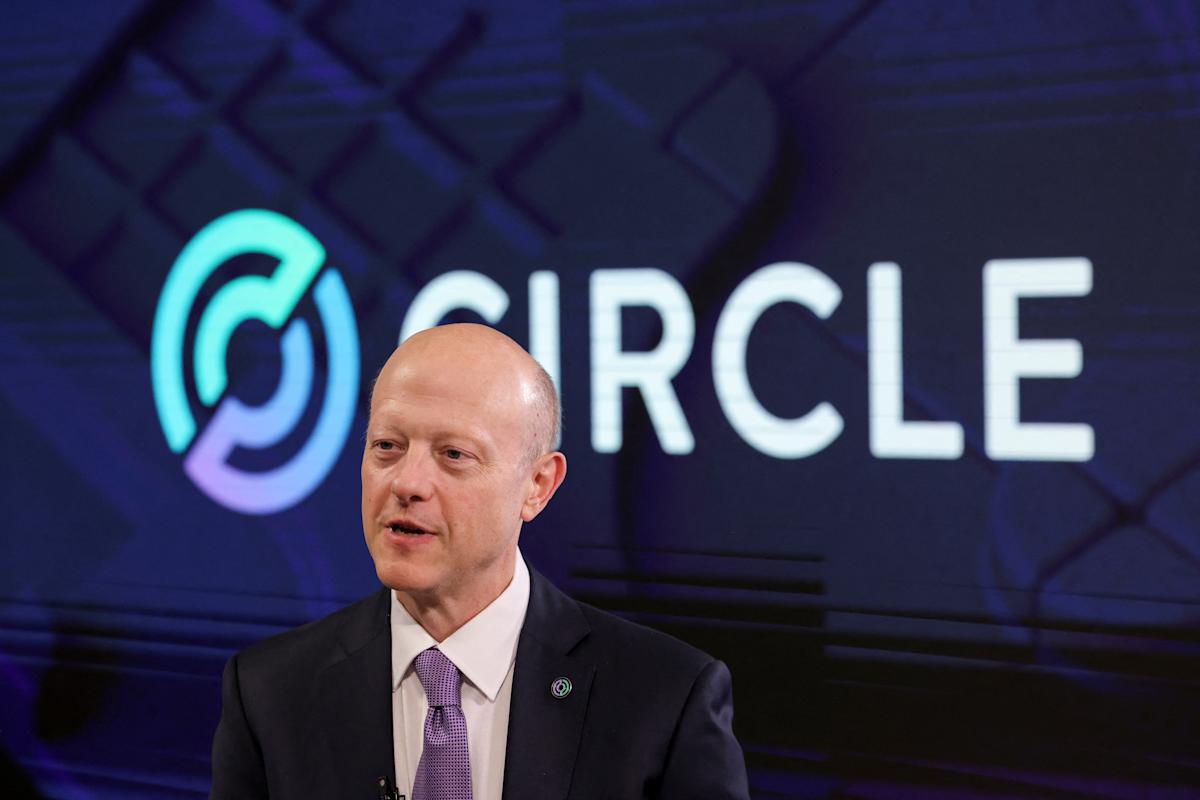
Jeremy Allaire, CEO and co-founder of Circle Internet Group, the issuer of one of the world’s biggest stablecoins. REUTERS/Brendan McDermid ·REUTERS / Reuters
“Microtransactions are a poor fit for traditional rails in terms of cost, latency and programmability,” Mark Palmer, an analyst at Benchmark-StoneX, said, adding that “AI agents would benefit from programmable money that can be embedded directly into software workflows without long settlement windows.”
Both companies are already spending to make the vision real. Circle introduced Arc, a new blockchain for stablecoin payments, and recently began testing a new capability for what it calls “nanopayments,” allowing autonomous agents to hold a balance and spend across networks with transaction costs of only fractions of a penny, small enough to make machine-to-machine commerce economical in a way that card fees never could.
Stripe is also making a big bet. With crypto venture firm Paradigm, it’s building Tempo, a blockchain designed specifically for stablecoin payments. The project raised $500 million at a $5 billion valuation, Fortune reported last year. Visa, Mastercard, UBS and Shopify are among partners on the initiative. Stripe has spent more than $1.1 billion acquiring stablecoin infrastructure, including the 2025 purchase of Bridge.
The infrastructure push extends beyond Circle and Stripe. Last year, Shopify partnered with Stripe and Coinbase Global Inc. to let merchants accept Circle’s USDC, and announced plans to offer 1% cash back to customers who pay with stablecoins. Coinbase launched a payments platform for merchants and incubated x402, an open standard designed for agentic payments.
But the gap between ambition and adoption remains stark. x402 reports $24 million in total volume across 94,000 buyers and 22,000 sellers over the past 30 days — against a global e-commerce market expected to reach $6.88 trillion this year.
“What we generally hear from merchants is that they’re agnostic to what payment methods they accept, but they aren’t going to bother accepting something unless they are asked by a meaningful number of consumers to do it,” Chris Donat, head of payments and fintech research at BWG Global, said. “I would not put stablecoins in the category of things that consumers are asking to pay with.”
He added that projections of agentic commerce reaching upward of 20% of e-commerce are “kind of aggressive.”
Even in an agent-driven world, stablecoin transactions lack the fraud protection, dispute resolution, and credit extension that cards bundle into every payment. A potential near-term path may be less dramatic than cutting out the networks: agents transacting using virtual cards that settle on the back end via stablecoins, allowing card networks and stablecoin rails coexist rather than compete.
Photographer: M. Scott Brauer/Bloomberg
“People want confidence, accountability, and reassurance that someone has their back when AI acts on their behalf,” a Mastercard spokesperson said in a statement, adding that as AI agents take on more responsibility, trusted infrastructure becomes more important.
Allaire said the timeline for when agent transactions would translate into meaningful volume remains uncertain. Circle’s stock, meanwhile, is up nearly 30% since the start of the year despite falling almost 60% from its frothy high of $263 reached shortly after its public offering in June.
An increase in USDC held on platform, instead of on external exchanges like Coinbase Global Inc., in addition to growth of its newer business lines including Circle Payments Network and Arc blockchain have buoyed the stock in recent weeks. Allaire’s agentic commerce comments are also hitting the market at the right time, John Todaro, an analyst at Needham & Co. said.
“Management did a pretty good job on commentary related to agent pieces, especially at this time in the equity market where AI is so disruptive to stocks,” Todaro said. “It does go fairly far if you can ride that as a tailwind versus AI looking like a headwind or a disruption to your business.”