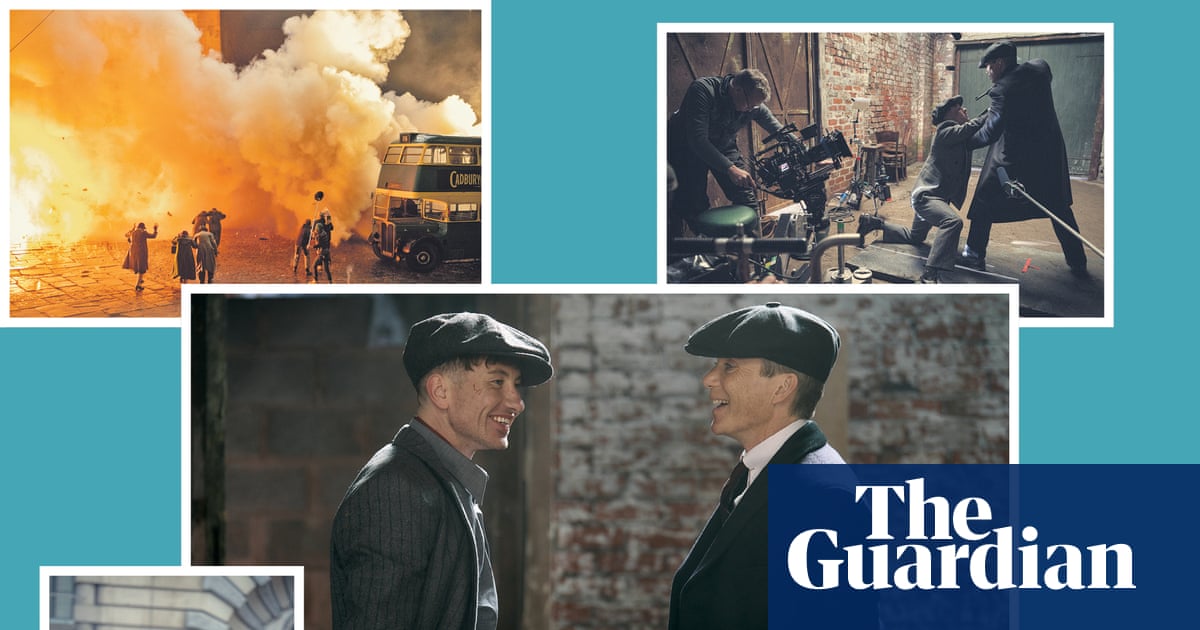
In June 2023, Barry Keoghan texted Cillian Murphy to wish him a happy Father’s Day. The pair had shared the screen six years before, in the film Dunkirk. “Cillian and Colin [Farrell] are people I admire greatly, and always keep in touch with,” says Keoghan. A reply from Murphy pinged back soon after: “Thank you. Would you like to play my son in Peaky Blinders the movie?”
Murphy remembers it a bit differently: that he was the one initiating contact (which is how Tim Roth and Rebecca Ferguson came on board). But he’s happy to let Keoghan’s version be recorded as fact.
“That’s a better story!” he says. “And I’d definitely forgotten it was Father’s Day. Maybe no one was paying attention to me at home?”
Anyway, Murphy continues, Keoghan was always his first choice to play Duke, errant idiot son of Tommy Shelby (Murphy) in the BBC and Netflix drama’s big-screen swan song. (The character was first introduced in season six, then played by Conrad Khan.) “Barry’s a firecracker – put a camera on him and all of a sudden he’s riveting,” he says. “There’s a danger to him … an unpredictability, which I think you need for that character. But also this vulnerability. And vulnerability on screen is a superpower as an actor.”
Peaky Blinders’ sixth season – in which Tommy battled Oswald Mosley, navigated the end of prohibition, avenged the murder of his aunt Polly and grieved his daughter Ruby, all while being fooled into believing he was terminally ill – wrapped up in 2022. The final scene saw Murphy’s brooding antihero riding off into the mist on the back of a white horse to do who knows what.
The film picks up six years later, in 1940, with Nazi bombs falling on Birmingham. Tommy is holed up in his draughty country mansion, having cut himself off from his family. He tries to write his memoirs, but is regularly distracted by the lure of his opium pipe and harrowing visions of his many dead relatives.
His gang is now run by Duke, unscrupulous even by criminal standards, who’s running contraband and has done a deal with John Beckett, a British Nazi agent played by Tim Roth, to flood the country with millions in counterfeit money and swing the war in Germany’s favour. We first see Keoghan’s character administering a beating to a police officer with chilling efficiency. Today, in a London hotel, the actor is all smiles and eye contact beneath the mop top – he is playing Ringo Starr in Sam Mendes’s upcoming quartet of Beatles movies.
Keoghan is a big Peaky fan – his decision to name his own dog Duke predates being cast as the character – so he understood the pressure. “I know there’s a wild fanbase and they will have expectations of this film,” he says. “So it’s impossible not to feel that. But I was made to feel very welcome. And getting to work with Cillian – what a joy.”
Joy is not the word that comes to mind during the first scene the characters share: a fight in a pigsty. Presumably whatever the pair end up caked in was not the real thing?
“No, it was shit,” says Murphy. “Pigs shit a lot.” He shudders, lost in memories. “They really do shit. And we were in it.”
“That was my first day of filming,” says Keoghan. “I cracked all my knuckles open, too. I remember punching the ground and Cillian saying, ‘Oh man, you don’t have to do that.’ But I wanted to, I needed to rev myself up to go for him. It was a great day!”
Watching Murphy march angrily towards him was the highlight, he says. “He had become Tommy Shelby. I was like, ‘Wow. I’m in trouble now. Where’s Cillian gone?’”
Peaky Blinders’ six-series run on the small screen was one of increasing returns and outlandish impact – and not just in terms of millinery. It started as a cult favourite drawing just over 2 million viewers, but at its peak was pulling in nearly triple that. Three key factors appear to have steered the success of the show created by Steven Knight, whose credits include the films Dirty Pretty Things and Locke, as well as the Disney+ series A Thousand Blows and the BBC’s SAS: Rogue Heroes. (He also co-created Who Wants to Be a Millionaire.) First, word of mouth, second, a move from BBC Two to One, and third, the show’s acquisition by Netflix in 2014 for a global audience – it’s available in 190 countries.
Murphy thinks it’s mostly down to word of mouth. Pre-Peaky fever, he says, the BBC didn’t really promote it. “The success is entirely fan-generated. It didn’t get any internal advertising on the BBC. I remember sitting down to watch the first episode and the announcer said ‘Coming up next, Peaky Blinders starring Sillian Murphy … and I thought, ‘Oh fuck this’, turned off the telly and went to bed.”
It’s difficult to pinpoint exactly what fans love so much about the show. It is at its core a gangster saga with some moments of outrageous violence, but it’s also a period family drama. When Knight met the boxer Oleksandr Usyk, he told him that Peaky Blinders is his favourite show because he sees it as an accurate depiction of family life. The draw of Murphy cannot be understated, nor of the ensemble cast, which has at times included Tom Hardy, Stephen Graham, Paul Anderson, the late Helen McCrory, Adrien Brody, Sam Neill, Aidan Gillen and Charlotte Riley. There are also the hats.
In 2019, the inaugural (and, to this date, only) Legitimate Peaky Blinders festival delivered “an immersive recreation” of the show to 15,000 punters, including live music, fashion shows, free haircuts, a Gypsy camp and (staged) bare-knuckle fights. Cosplay was much in evidence. But I also had the suspicion that those clothes may have become many people’s everyday outfits.
While much of the series was filmed in Liverpool, Manchester and parts of Yorkshire, tourism in the West Midlands has blossomed since the first episode aired in 2013. Notable pilgrimage sites include the Black Country Living Museum (filming location of Charlie’s yard) and Digbeth Loc in Birmingham, the studio complex founded by Knight where much of the new film was shot.
In the UK, the series is credited for helping Arthur, the name of Tommy’s elder brother, become one of the most popular boys’ names – it was fourth on the list in 2024 – while Ada, the name of their sister, entered the top 100 for girls in 2018 for the first time since the 1920s, and has now reached the dizzy heights of 56.
In Afghanistan last year, four men were ordered to report to the Taliban’s department of vice and virtue for dressing as characters from the show. They have since been released, with Saiful Islam Khyber, a spokesperson for the Taliban government, telling the BBC: “Even jeans would have been acceptable, but the values in the Peaky Blinders series are against Afghan culture.”
A division of the Ukrainian national guard is called the Peaky Blinders on account of the Peaky-esque baker boy hats they’ve adopted. To show their support upon hearing about them, Knight sent over 30 new hats and signed one. Cillian Murphy signed another.
For Knight, the moment he realised there had been a significant shift in the show’s reach was when he got a call from Snoop Dogg’s agent. “He said: ‘Snoop is in London. He wants to meet two people and you’re one of them.’”
For three hours in a hotel bar the pair swapped similarities between the Peaky Blinders and Snoop’s time with the street gang the Crips in Long Beach, California. Brad Pitt also rang Knight wanting a role in the series, but sadly it never came to be.
Once the show wrapped, Knight and his cast were not short of work. Murphy won the leading actor Oscar for Oppenheimer. Knight has just completed the script for the new James Bond movie. (When I ask him about this, it’s the only time he clams up. “I honestly can’t say anything about it,” he says. “Not what stage it’s at, whether I’ve finished it, nothing. Let’s just say I’m in the process. I’m loving it, and don’t feel any pressure. How could I? If I worry about it I’m stuffed.”)
So why revisit Shelby and co? Unfinished business, it seems. The impulse for one last job.
“I’m so proud of the TV series,” says Murphy, “and if you’re going to make a film, the story needs to have a reason for existing.”
Knight agrees, but adds that he’d always imagined Peaky – as the show is referred to by all involved – ending on the big screen. (Although, in fact, the franchise will continue on the telly; a new 1950s-set spin-off is now filming.)
The star and writer, along with director Tom Harper, then whittled down the plot, while Murphy texted actors to bring them onboard. After Keoghan came Ferguson, with whom he shares an agent, who Ferguson says she’d instructed: “‘Just give me a shooting schedule – I’ll turn up, I’ll wing it, see what I can do. I’ll do anything!’”
Then Roth, who’d contacted Murphy in the wake of his Oscar win to say congratulations “and all that bollocks”. Roth’s character, he says proudly, is – contrary to expectations – “very reasonable, just trying to end a war by whatever means. The term ‘geography teacher’ came to mind quite often,” he says. “I hated geography but I liked my teacher.”
In November 2024, I went on set at Calke Abbey, a National Trust property on the outskirts of Derby, which was doubling as Tommy’s house. It had snowed in the days just before. A dream for Knight, you’d think, who had long wished to shoot Tommy outside in the snow. In each of Peaky’s six seasons, he says, he’d written just such a scene, only for them all to be downgraded from snow to rain by producers keen to insulate their budget.
But the real stuff was, sadly, the wrong kind of snow, meaning it had to be cleared by production staff, before being added back in during post-production.
It wasn’t just the weather that brought headaches. Calke Abbey’s Grade-1 listed status meant there were strict restrictions on what could go on during filming. Producer Guy Heeley told me navigating these rules was all part of the fun, while looking very much like a man who had had enough of that kind of fun.
The abbey was mid-renovation during filming, which also didn’t add to its comfort levels. “That place was fucking freezing,” is Murphy’s main recollection of Derbyshire.
Watching him film a scene at Tommy’s writing desk was extraordinary. During the reset, Murphy stayed in character for what seemed like an age: brooding, repeatedly removing and replacing his glasses and aggressively smoking for maybe 15 minutes as cameras were moved around him. It was mesmerising.
Returning to the role was “a bit like putting on an old pair of shoes,” he says. “It’s more than just putting on the cap, I have to always spend a few months getting into that mindset, getting the physical shape and all of that. And there’s always a fuckload of words …
“It’s been a quarter of my life, Peaky Blinders, so I’m OK with this being it. As for the haircut: I hated it for so long, but then everyone in the world started getting it, so I thought maybe it’s not so bad after all?”
At one point, I potter into the costume trailer stationed in the abbey’s car park. Among the rails and rails of suits and frock coats and an elaborate leather jacket, I spot a key-coded safe. This, it turns out, is where Tommy’s cap is kept when Murphy isn’t wearing it. Now he won’t be needing it any more, I wonder where it is?


