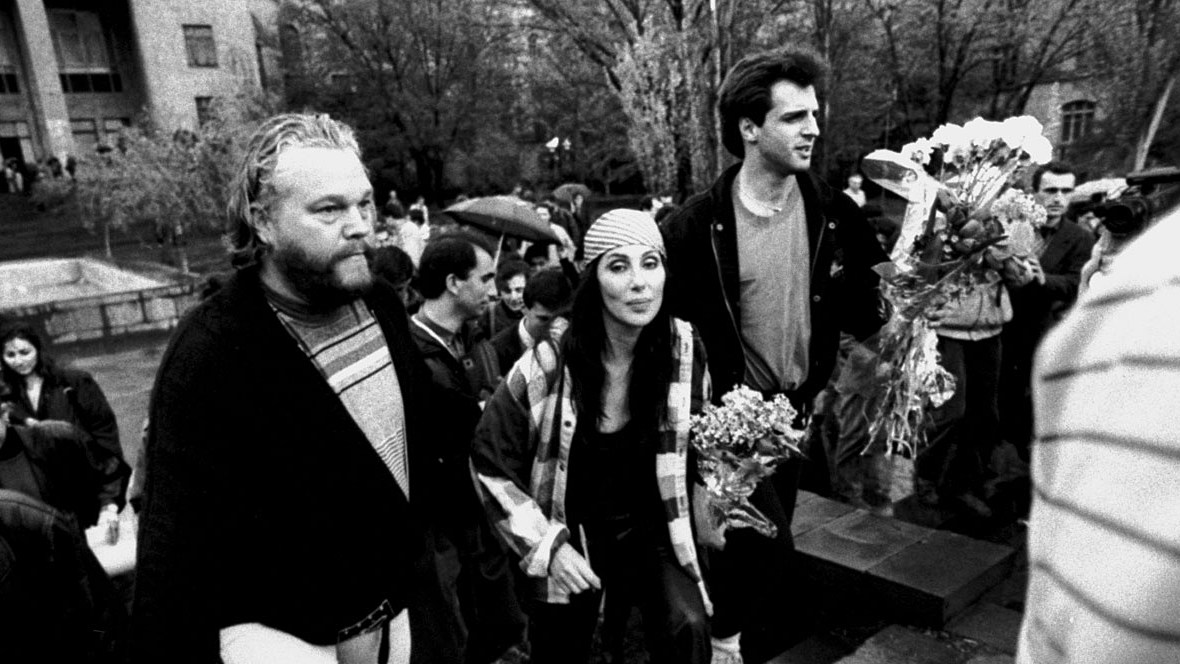
“You give a rock star a passport and their airline ticket and tell them what flight to catch,” Michael Francis once remarked, “but the chances of them getting to the other end in one piece, on the right plane and in the right country, are near enough nil.”
As bodyguard for some of the biggest names in rock, including Paul McCartney, Led Zeppelin, Kiss and Bon Jovi, Francis ensured his stars not only made it onto flights, but also got through their shows unscathed and survived the narcotic-fuelled parties afterwards. Much of his time was spent protecting stars from themselves.
An ex-boxer hardened by a spell as a West End drug dealer and a few East End pub fights, Francis brought plenty of brawn to the job, but it was often softer skills that helped him to get ahead. “To last with an artist for 16 months of a tour, you have to be their best friend,” he said. For Jon Bon Jovi, this meant ushering girls out of the room at five in the morning with believable excuses. For Kiss, in the later stages of the band’s career, it meant offering aspirin, ice packs and some TLC after shows: “They’ve all got rheumatism, but they still put on those 12-inch high boots and run around, you have to take care of them.”
Francis’s talent for using both his charm and his bulk to get stars out of scrapes would serve as inspiration for Dennis Waterman’s character Terry in the ITV show Minder. Francis, like Terry, seemed “gentle as a lamb”, Waterman wrote in his autobiography, “but if push came to shove, boy could he sort things out.”
Michael “Danny” Francis was born in 1950 in London to Joan (née Watts), a stallholder, and George Francis, a boxing trainer who worked with Frank Bruno and John Conteh. As a teenager Michael was, in his own words, “a bit of a rogue”. He got into fights often, including with one of his teachers at Holloway boys’ school who hit him on the head for not being able to read in class. Francis, who was dyslexic, knocked him down with one punch. He was just 11 years old.
At 16 he was dealing drugs in the West End, a short career that culminated in a gang fight at a venue called the Downbeat Club in Soho. One boy fatally stabbed another in the mêlée, and Francis was charged with affray and sentenced to nine months in a young offender institution.
The experience proved surprisingly constructive. It was a wake-up call and his fellow inmates achieved what his teachers never could, teaching him to read and write so that he could correspond with his family. After his release he tried to launch his own boxing career and began helping his father in the gym.
Francis published a book about his years as a bodyguard in 2003
One afternoon in 1974 they were training Conteh together when McCartney, who had recently featured Conteh on the cover of the Wings album Band on the Run, strolled in. Through the course of their conversation Francis, Conteh and McCartney ended up planning a trip to the cinema for a live showing of Muhammad Ali’s title fight with George Foreman. The night of the fight, Francis picked McCartney up from his home in St John’s Wood. “Out of the blue, Paul says to me: ‘I could use a guy like you’,” Francis recalled. “That was it.”
Through working as security for McCartney, Francis was introduced to Peter Grant, Led Zeppelin’s hard-nosed manager, with whom he worked for eight years. Zeppelin would prove to be much more challenging wards than Wings. They were rock stars at the height of their fame, the kind actually throwing TVs from hotel windows, and they received a £5,000 weekly “expenses” budget with little to no oversight of what it was spent on.
Grant himself was involved in many of the binges, leaving Francis to maintain some semblance of control. “The excess was outrageous,” he said, “it became total mayhem.” Even this was only an apprenticeship for his next challenge: the singer Paul Rodgers, who Francis said was always a “fantastic bloke” right up until the moment he’d had a drink. “We went through America with Bad Company and probably ended up in a fight of some sort every night.”
There were more fights to be had when Francis took on one of his longest posts alongside Jon Bon Jovi, although now the people he was dragging his charge off were more often other rock stars. There were tense stand-offs with Axl Rose, the Guns N’ Roses frontman, and a physical altercation with members of the heavy metal band Skid Row. In retaliation for the latter, Francis and his security team were said to have “bushwhacked Skid Row on stage, held them down and gaffa-taped them to chairs”.
Bon Jovi’s 1986 Slippery When Wet tour was, by Francis’s standards, “the best rock’n’roll tour of all time”, featuring all of the usual debauchery but none of the missed shows or lost band members. Over the six years he worked with him, Francis became one of Jon Bon Jovi’s closest friends and was even best man at his wedding. “It was amazing,” Francis recalled. “I was living a fairytale life. But that’s the thing about fairytales. One day you have to come back to reality.”

Francis backstage on a Kiss tour
The Bon Jovi era came to a sudden end when the band changed management and Francis was left off the new staff list. “I’d saved his ass on two dozen occasions,” Francis said of the frontman, “but in the end, that doesn’t matter.’’ He recalled something the band’s now ex-manager Doc McGhee had told him early in their working relationship: “Just remember, the artist is the enemy. As sure as we’re all going to die, you will get that fax or that phone call. And it won’t be from the artist; it’ll be from their attorney.”
Thankfully this maxim wouldn’t always prove true. Though his professional relationship with Bon Jovi went somewhat sour, it made way for one of his closest and most significant working relationships, with Cher. After receiving death threats from a crazed fan, the singer took Francis on for round-the-clock protection. For three years he had a room in her Malibu home, and accompanied her everywhere she went. “Working with Cher was the best job I’ve ever had,” Francis said later, describing her as like a sister to him.
It was also something of a relief to step away from touring with rock bands for a time. “It’s like any job,” he said, “after a while, you think ‘not another show, not another room full of beautiful women’; you’d rather play a round of golf.” Between 1999 and 2002, Francis lost his mother, brother and father in quick succession. It was a sobering time and he began to reflect on everything he’d missed while away on tours.
He was used to people expressing jealousy when they discovered what he did for a living and he enjoyed recounting stories from work, but Francis knew that every star-studded party and scandalous anecdote was secondary to the moments between tours that he was able to spend with his family. Many of these were with his wife, June, whom he married in 1970, and their three children, all of whom survive him. “They’re the memories that matter,” he said in 2003, a few days after turning down an offer to rejoin Kiss on tour. “Frankly, I don’t care if I see another rock band as long as I live.”
Michael Francis, bodyguard to rock stars, was born on August 16, 1950. He died on October 25, 2025, aged 75


