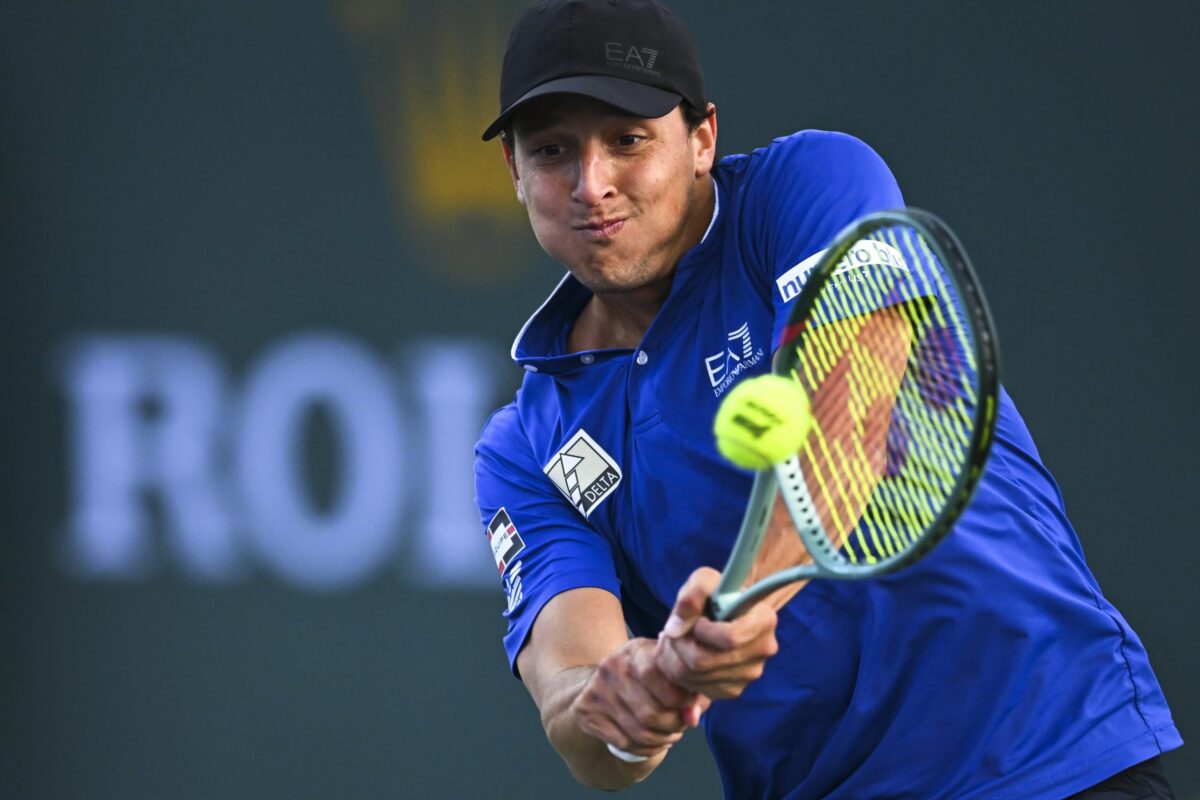
Mattch point down in the second round at Indian Wells, Luciano Darderi lobbed a defensive ball into the air and pointed toward the crowd. He stopped playing. Rinky Hijikata, already moving forward to end the match, was left looking confused. The chair umpire called a halt. A video review was requested, and then the match was over, awarded to Hijikata because, under the rules of the sport, the umpire could find no evidence that Hijikata or anyone on his side of the net had caused the hindrance. Which meant that Darderi, by stopping, had hindered himself. Match to the Australian qualifier.
The crowd did not like it. Social media did not like it. The chair umpire informed Darderi that players are not permitted to stop points simply because someone in the crowd screams, annoying as it is, and that the video review had determined Darderi had, in fact, hindered Hijikata by stopping the point. The logic is airtight. The outcome felt cruel. Both things can be true simultaneously, and that gap is precisely the place where the ongoing debate about video review in tennis lives.
What Actually Happened, and What the Rules Say About It
The facts of the incident are reasonably clear. Darderi defended a deep ball and pointed out in front of him, stopping play while appearing to gesture somewhere between Hijikata’s end of the court and the crowd. On the match audio, a spectator clearly and audibly reacted. Darderi told Hijikata at the net that someone had called out. Hijikata shrugged. He had not said anything. A voice in the background does appear to have shouted something just as Darderi hit the ball back into court, and while the precise word is disputed, nobody seriously doubts that Darderi heard something and genuinely believed he was entitled to stop. The problem is that the rule does not care about genuine beliefs. It cares about what the camera can verify.
And this is the central tension that the proliferation of video review in tennis has not resolved. It has exposed it.
Tennis has reached for the camera as a solution to human fallibility with the implicit assumption that more oversight equals more accuracy, and more accuracy equals more justice. The Hawk-Eye line-calling system, now automated across virtually the entire major tour, is a genuine success story within its narrow brief. A ball is either in or out. The technology is more reliable than the human eye. Everybody won.
Hindrance is not binary. It is among the most interpretive calls in sport. Under the ITF rules, a player can be penalised for hindrance if they deliberately or inadvertently interfere with their opponent’s ability to play a shot, and that interference can be physical or auditory. Timing and context, including ball speed and duration of vocalisation, are key to how these calls are assessed, and consistency in enforcement remains a persistent challenge, especially when players’ vocal habits vary widely. That last observation, the one about consistency remaining a challenge, is crucial. You cannot automate judgment. You cannot run a frame-by-frame replay of a contested intention.
The Pattern Emerging Across the Tour
The Darderi case is the starkest illustration of this so far in 2026, but it is not the only one. At the Australian Open, Aryna Sabalenka was penalised for hindrance after her usual grunt shifted in pitch. She had expected a ball to go out, let out a noise of frustration, and the ball landed in. The chair umpire ruled that the extended sound had hindered her opponent as she moved to play the return. Sabalenka called for a video review. The umpire held firm. The sound Sabalenka made was not her normal sound. That was the ruling. Sabalenka was not happy.
A few weeks later in Rio, Daniel Altmaier played a brilliant drop shot, assumed he had missed it, cried out in anguish, and lost the point he had just won. The chair umpire correctly called a hindrance and awarded his opponent a point he would have lost had Altmaier simply kept his mouth shut. Technically correct. Experientially absurd. The video confirmed the sound was made. It could not confirm whether it disrupted anything.
This is the problem that no camera resolves. In Sabalenka’s case, the video evidence was used to verify that she made a specific sound at a specific moment. It told the umpire nothing she did not already know. She already knew Sabalenka made the sound. The question was whether it constituted a hindrance, which is a judgment about the effect the sound had on an opponent’s cognitive state during a fraction of a second at high speed. No replay can measure that. The umpire made a call. The review confirmed the sound existed. Those are two entirely different questions, and the technology conflated them.
The Darderi case is even more convoluted because, as the review played out, Darderi’s own understanding of the sequence shifted several times. At one point, he appeared to believe he had not pointed or stopped until the umpire intervened. The footage was clear enough on the raw facts. He pointed and stopped. The spectator shouted. What the footage could not determine, what no footage ever can, is whether a ball travelling at pace, a crowd noise, a player’s physical gesture, and the split-second decision to stop were causally connected in a way that constitutes a legitimate hindrance plea. The umpire decided they were not. The camera confirmed the sequence. It adjudicated nothing.
What the Camera Can and Cannot Do
What video review does very well is this: it catches bad line calls, confirms double bounces, verifies code violations that were visually confirmed and then disputed. The technology is superb when the thing being reviewed has a correct answer that can be extracted from visual data. Where it fails, and where tennis has been quietly papering over that failure with the theatrics of reviews and headphones and big-screen replays, is anywhere a correct answer requires understanding intent, effect, or experience.
Hindrance is the most obvious example of this problem, but it is not the only one. The same limit applies to whether a grunt was deliberately timed to distract, whether a player’s injury timeout was genuinely necessary or tactically motivated, whether a delay between first and second serve was intentional, whether a code violation for verbal abuse involved actual malice or a private mutter misheard by a microphone two meters away. The camera adds evidence. It does not add judgment.
The sport should be honest about what it has. It has excellent technology for a specific, limited set of binary decisions. For everything else, the grey areas that actually shape the most memorable and controversial moments in any match, it has a chair umpire with a headset and a difficult job, supported by a replay system that usually confirms what everyone already saw and settles nothing about what it meant.
Luciano Darderi is on a plane to Miami. Rinky Hijikata plays Alexander Bublik next. The camera watched all of it. It saw everything and explained nothing.
Main photo credit: Jonathan Hui-Imagn Images


