Unusually, this weekend, the main talking point in English sport was not football.
Despite Port Vale’s hugely impressive win over Sunderland, the FA Cup fifth round served up an entertaining set of matches without any true giant-killings, so the focus was instead on rugby union. In Rome, Italy recorded their first victory over England in 32 attempts, an unthinkable result a couple of decades ago. In a sport based upon physicality and hard running, Italy can now defeat England. In football, it feels like a very different story.
The theme of the 21st century, in terms of football style, has been globalisation and therefore uniformity. Whereas countries developed distinct, unique styles of football in the 20th century, owing to climate, geography, the traditions of other sports and the preferences of fans, recently things feel more familiar. The post-Bosman explosion in the movement of footballers (and managers), the increased number of continental matches, and the development of communication technology mean foreign football is studied, analysed and replicated across international borders in ways that would once have been impossible. At one point, every big side around Europe seemed to be copying Barcelona.
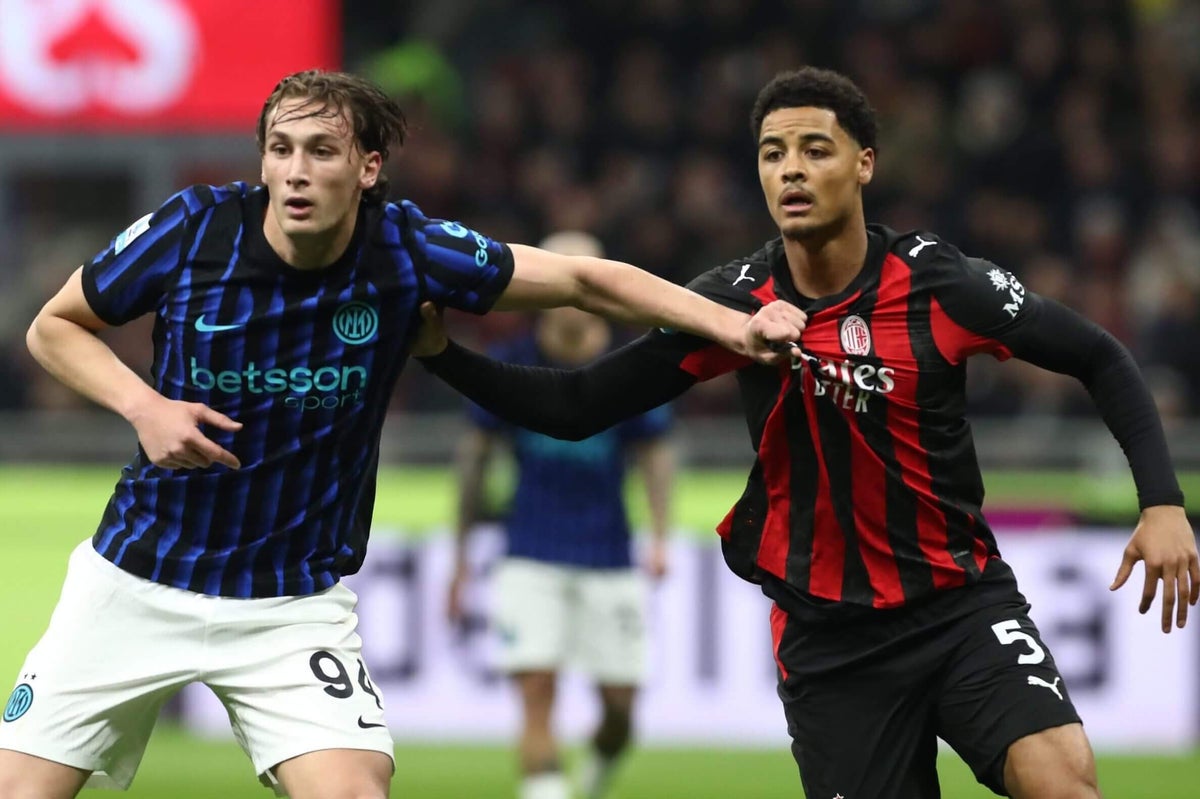
Yet if you watched the Milan derby on Sunday night, having been accustomed to watching Premier League football, you could be forgiven for thinking you were watching a different sport. Milan ran out 1-0 winners over Inter, completing the double over the Serie A leaders this season. The match was sluggish and slow-burning. And it was hugely enjoyable.
Italian football now exists in its own little world. In no other top league would you witness the top two lining up in 3-5-2 systems, a formation battle that always feels limiting. Both defences have a spare man. The centre of the pitch is congested, although the deepest midfielder can generally find space to dictate play. The wing-backs spend much of the game chasing one another up and down the touchlines. The tactical battle at San Siro was about both sides trying to engineer an overload by pushing a wide centre-back forward to support a wing-back, and then crossing.
The only goal came from an excellent move, when Milan’s Youssouf Fofana played a one-two with Rafael Leao, then slid a neat ball in behind for Pervis Estupinan, racing in behind opposing wing-back Luis Henrique to smash home. This was the classic type of goal you expect with this formation battle. You won’t find players between the lines, and the strikers are tasked with coming short to link play. The space is always out wide.
Inter’s best chance, incidentally, came from their left-wing-back, Federico Dimarco, at the start of the second half. He blazed over from close range.
Aside from wing-backs who enjoy breaking into space, there are certain players who thrive in slow-tempo contests. The most obvious example is Luka Modric, still going strong at 40. Modric is still magnificent in possession and could do a job for any side in Europe, but his role — and in particular his playing time — would be more limited in any other top league.
He started 17 games for Real Madrid last season, but was used as a substitute 18 times. This season, no Milan outfielder has started as many games as Modric. He has completed 90 minutes on 21 occasions, more than in any of his 13 seasons at Real Madrid. In the closing stages against Inter, Modric wasn’t sitting deep and holding his position, but trying to dribble into the final third. All this is a testament to his longevity — he played at the World Cup 20 years ago — but also to Serie A’s relaxed tempo.

At the opposite end of the age scale is Inter’s Pio Esposito, a 20-year-old striker hyped — somewhat unfairly — as Italy’s saviour, in the month they desperately try to avoid a third straight World Cup qualification failure. Esposito is a genuine talent who is seemingly being tracked by every major European club. But again, surely only in Italy would the great new hope be a player in his mould.
This is not a lively, tricky, creative attacker who feels electric on the ball, but a 6ft 3in (190cm) centre-forward who backs into defenders and likes challenging in the air. There’s nothing wrong with all that — other major European countries aren’t producing enough specialists these days — but it does point to Italy having a somewhat antiquated approach to player development.
From an English perspective, it feels odd that Fikayo Tomori and Lloyd Kelly can be regulars in defence for Milan and Juventus respectively, yet be nowhere near the England squad. Tomori hasn’t been capped for over two years, and Kelly has never been called up. Granted, at times, English football has been too insular and has ignored those playing abroad. Maybe it reflects the difference in quality between the Premier League and Serie A. But it’s also the fact that Tomori and Kelly are playing a completely different style of football from that played in the Premier League.
While Serie A is broadly comparable to Ligue 1, the Bundesliga and La Liga in terms of sprinting, it has been roughly at the same level for the last five years, while other leagues have become quicker.

The problem with playing football in slow-motion is when it comes to continental competition. Serie A clubs’ poor performance in the Champions League this season has received plenty of coverage, but this isn’t a new problem.
In both 2000-01 and 2001-02, somewhat closer to the glory days of the 1990s, Italian football failed to get any sides into the quarter-finals of the Champions League. Since then, there’s been something of a recovery. But on the biggest stage, Italian clubs often get overrun. PSG’s 5-0 thrashing of Inter in the final last season was the obvious case study.
“I’m going to repeat myself, but I insist, in Serie A we play at too slow a pace,” Fabio Capello said last season. “And the many referee breaks certainly don’t help. It is no coincidence that when we cross the borders of our league, we often get into trouble.”
In fairness, Italian football has taken action with regard to the refereeing. This season, there’s clearly been a shift towards letting the game flow and refusing to indulge players lying down after a bit of physical contact.
If Serie A and the Premier League have something in common, it’s that neither of the probable title winners are convincing. Arsenal are clearly lacking in attacking flair. Inter’s problem is different: they’re terrible in big matches. They’ve lost both derbies against second-placed Milan and collected only one point from their two matches against third-placed Napoli. They lost to Atletico Madrid, Liverpool and Arsenal in the Champions League group phase. They did defeat Dortmund, granted, before losing both playoff legs against Bodo/Glimt.
Dedicated followers of Serie A tend to get defensive about any critique of the league from outsiders, but following Italian football as an outsider is, in roughly equal parts, about having a strong affection for the league, while also slightly despairing of it.
The Milan derby — painfully slow, but hugely enjoyable — was a good example of why.


