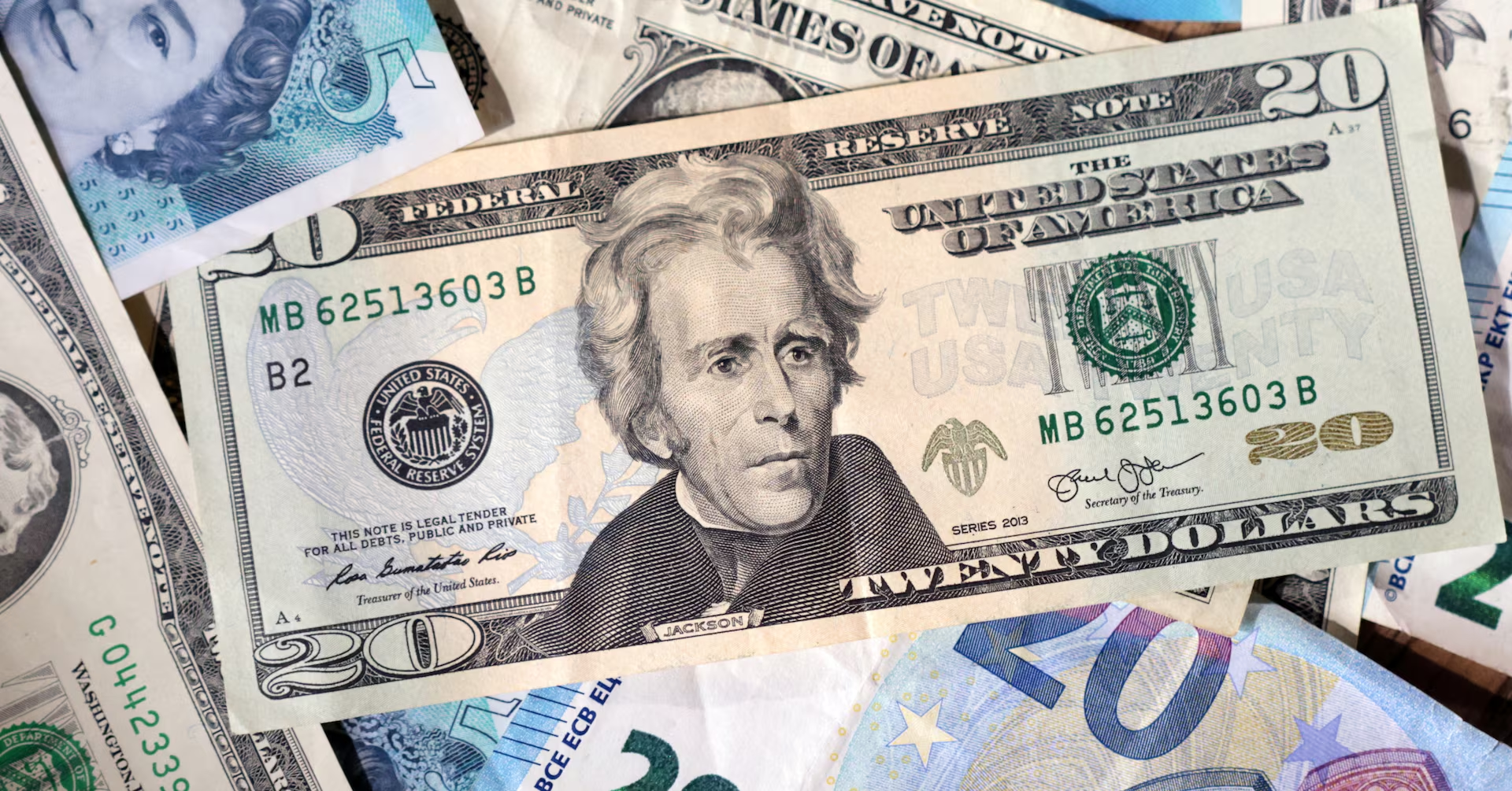
Nov 27 (Reuters) – The U.S. dollar headed for its steepest weekly drop in four months on Thursday as investors bet on further monetary easing, amid pressure from President Donald Trump to cut rates.
Sign up here.
U.S. markets are shut for Thanksgiving, leaving liquidity thin and amplifying trading moves.
“That could be an attractive environment for Japanese authorities to intervene in dollar/yen,” said Francesco Pesole, forex strategist at ING.
“However, there may still be a preference to intervene after a dollar-negative data event, and the stall in the pair may have removed some sense of urgency,” he added.
RATE OUTLOOK WEIGHS ON DOLLAR
The U.S. dollar index was up 0.1% at 99.65, having retreated from a six-month high hit a week ago to head for its largest weekly drop since July. It is currently down 0.54% on a weekly basis.
Mark Haefele, chief investment officer at UBS Global Wealth Management, urged investors to review their currency allocations as the appeal of the U.S. dollar fades, recommending the euro and Australian dollar over the greenback.
Views on the dollar’s outlook remain divided.
“We’ve gone through a period where rate differentials and euro growth expectations clearly benefited Europe over the U.S.,” said Themos Fiotakis, global head of forex strategy at Barclays.
“Looking ahead, some of those assumptions are being challenged. The euro’s expensiveness is one reason, but the robustness and resilience of the U.S. economy is another,” he added.
EURO, SWISS FRANC AFFECTED BY UKRAINE PEACE TALKS
The euro dropped 0.13% to $1.1581, after hitting a 1 1/2-week high earlier in the session at $1.1613.
Markets are watching negotiations over a possible Ukraine peace deal, which could lift the single currency.
An agreement would instead weigh on the Swiss franc given its role as a geopolitical safe haven, but analysts say there is little sign of a ‘peace dividend’ yet as uncertainty remains high.
The dollar hit a one-week low against the Swiss franc at 0.8028, and was last up 0.20% at 0.8060.
AUSSIE AND KIWI ON THE RISE
A resurgent New Zealand dollar skipped out to a three-week peak of $0.5728 and has gained about 2% since a hawkish shift at the central bank a day earlier.
That contrasts with more than 90 basis points of cuts priced for the U.S. Federal Reserve between now and the end of next year.
Australia’s 3-year and 10-year rates of 3.86% and 4.5%, respectively, are the highest in the G10, which analysts said makes the currency look cheap.
At $0.6536 the Aussie is in the middle of a channel where it has traded for about 18 months.
Pushback from China’s central bank fixing mechanism steadied the yuan at 7.08 per dollar on Thursday.
Reporting by Stefano Rebaudo, additional reporting by Tom Westbrook; Editing by Shri Navaratnam, Sam Holmes, Ros Russell and Alexander Smith
Our Standards: The Thomson Reuters Trust Principles.


