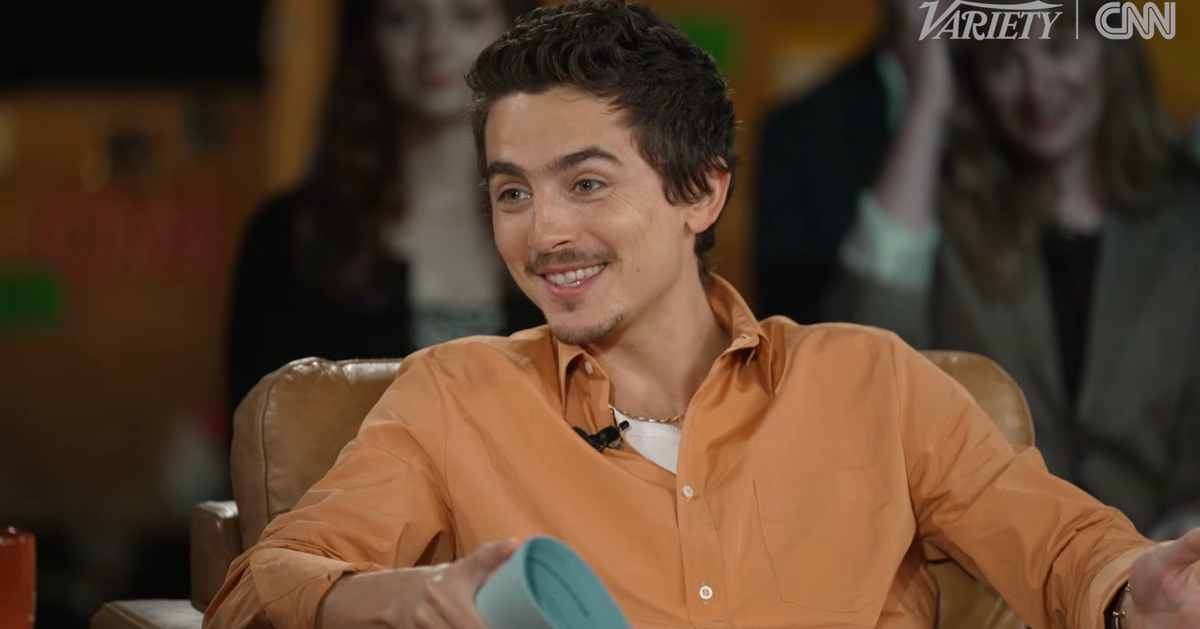
Timothée Chalamet couldn’t have hit a lower note among his artistic peers last week.
The “Marty Supreme” actor’s recent comments dismissing ballet and opera as arts “no one cares about” led to public ridicule and backlash within the entertainment world, including pushback from legendary Italian opera singer Andrea Bocelli and American ballet dancer Misty Copeland.
But it also led to opera and ballet professionals challenging Chalamet with an outpouring of online commentary and videos that showcase their talent, passion and success while emphatically proving that the centuries-old arts are anything but dead.
“He seems to think that art is only valuable if it can produce money and fame for the artist, and that’s just not how art works. The value of art is intrinsic to the art itself, not how much money or fame it can get you,” New York City-based dancer Stefanie Renee Salyers, who spent years studying as a ballet dancer before entering dance theater, told HuffPost. “We deserve to be respected, even though we aren’t millionaires or dating Kylie Jenner.”
Salyers was among those who joined in on challenging Chalamet’s comments on social media, sharing footage of her dance performances and humorously taking a dig at his singing chops in “Wonka.”
Salyers pointed out that many artists like her have dedicated their entire lives to a craft, which often doesn’t pay well and may require multiple side jobs to study and perform ― “not because they want money and fame but because they love and value and respect the art itself.”

BARBARA GINDL via Getty Images
That appears related to the United States’ “really weird relationship with anything that’s not a capitalist project,” she said, because many other developed countries ― like Germany, France and Finland ― offer substantially greater public funding for the arts, making them more accessible and widespread. (A 2000 analysis by the National Endowment for the Arts found that the U.S.’s direct per capita government spending on the arts was the lowest of any country tracked.)
“Like in Russia, everyone goes to see a ballet and the ballerinas in Russia are as famous as Timothee Chalamet,” she said. “They’re recognized on the street. People are like, ‘Oh my gosh, it’s [so and so], can I get a picture with you?’”
“He seems to think that art is only valuable if it can produce money and fame for the artist, and that’s just not how art works.”
– Stefanie Renee Salyers
That’s not to say that ballet and opera companies aren’t thriving in the U.S.
At the San Francisco Ballet, home to the nation’s oldest professional ballet school, they say they’re too busy to give Chalamet’s comment much attention.
“We know who we are,” said Tamara Rojo, who serves as SF Ballet’s artistic director and was a lead principal dancer. “We know what we represent and we know the state of our organizations and our industries and the place they hold in humanity.”
Within the last three years, the ballet company, one of the country’s most prestigious, has seen its revenue grow by more than 40%. Interest in ballet training among children is also greater than ever, Rojo said.

Robbie Jack via Getty Images
“I think what is true, is that all of the creative industries, including the one that Mr. Chalamet is part of, have struggled to come back from the pandemic,” she said of the prologned period in which people were stuck at home, but still turning to art ― in books, films, music and digitized performances ― to help stay sane.
“But certainly, ballet, and the creative industries and the performing arts industries, they have always had to face challenges,” she said. “We are, I think, at this time more important than ever and what we need is to come together to support each other.”
Operatic soprano Soula Parassidis, who produces blends of classical and modern music through her program Living Opera, also said that Chalamet is judging art “by the wrong metrics” and repeated that all artists are better off supporting one another.
“Some things are made primarily for consumption, while others help form us as human beings,” said Parassidis, who, like Salyers, has posted videos showcasing her powerhouse vocal cords and humorously shading Chalamet and his “billionaire girlfriend.”
“What feels inaccurate in his comment is the suggestion that opera and ballet are merely relics people are trying to keep artificially alive out of habit or cultural obligation. That is not why we keep producing and performing them. We return to great artists like Mozart and Verdi year after year because their work still helps us understand ourselves more deeply,” she said.

Opera and ballet are also unlike the movies, with each live production offering the audience an opportunity to witness intense discipline, memory, physical control and emotional intelligence, “all in real time and in front of an audience,” she said.
“There is no edit button. Mistakes can happen, and in a sense that is part of the thrill. Every performance is alive, and no two experiences are ever exactly the same, even when the work itself is familiar,” she said.
It’s part of why she and Rojo said they would encourage someone to pursue their arts, with Parassidis arguing that opera “builds resilience, focus, discipline, and seriousness of purpose, and those qualities remain valuable whether or not someone ultimately chooses to pursue the art form professionally.”
“Training to become an opera singer is a lot like training to become an elite athlete. Many people are surprised to learn that we do not use microphones, but rely entirely on physical power and vocal technique to project our voices,” she said.
Rojo also stressed that the arts and creativity are needed more than ever for children as they prepare to enter uncertain careers featuring all-new technology.
“We know we need to prepare them to be imaginative, entrepreneurial, emotionally resilient. That’s what the arts can give them. That inside window into their own emotions, their ability to express them in a healthy manner,” she said.
Asked what works of art all three women would recommend to someone wanting to experience opera or ballet for the first time, they all named Tchaikovsky’s “The Nutcracker” ballet as an obvious one, as the magical production is a winter staple across the country.
“It’s only two acts. It’s Christmasy. It’s fun,” said Salyers, who also recommended the ballets “Swan Lake,” “Coppelia,” and “Giselle.”

Rojo also said that it depends on one’s tastes, with her ballet company offering more contemporary productions, including ones featuring pop music or tech, like its ballet “Mere Mortals,” which is about artificial intelligence.
As for opera, Parassidis recommended “Carmen,” “Don Giovanni,” and “La Bohème,” saying these 18th- and 19th-century theatrical masterpieces “have endured for a reason.”
“The drama is strong, the music is iconic, and they offer an immediate emotional connection even for someone new to opera,” she said. “And
as we celebrate 150 years of ‘Carmen,’ there is a good chance your local opera
company is programming it.”
Those heading to an opera for the first time can check out this handy intro guide prepared by the artistic director of the A.J. Fletcher Opera Institute at the University of North Carolina.
Correction: An earlier version of this story misidentified Tamara Rojo as a current lead principal dancer with the San Francisco Ballet.


