Apple’s next high-end silicon has surfaced in its first benchmark — and the numbers are substantial.
A Geekbench 6 result for a 16-inch MacBook Pro powered by the new M5 Max chip appeared online, showing the fastest CPU performance ever recorded for an Apple silicon processor. While the listing remains unconfirmed, the results point to a meaningful generational jump.
If accurate, the M5 Max is now Apple’s most powerful consumer chip to date.
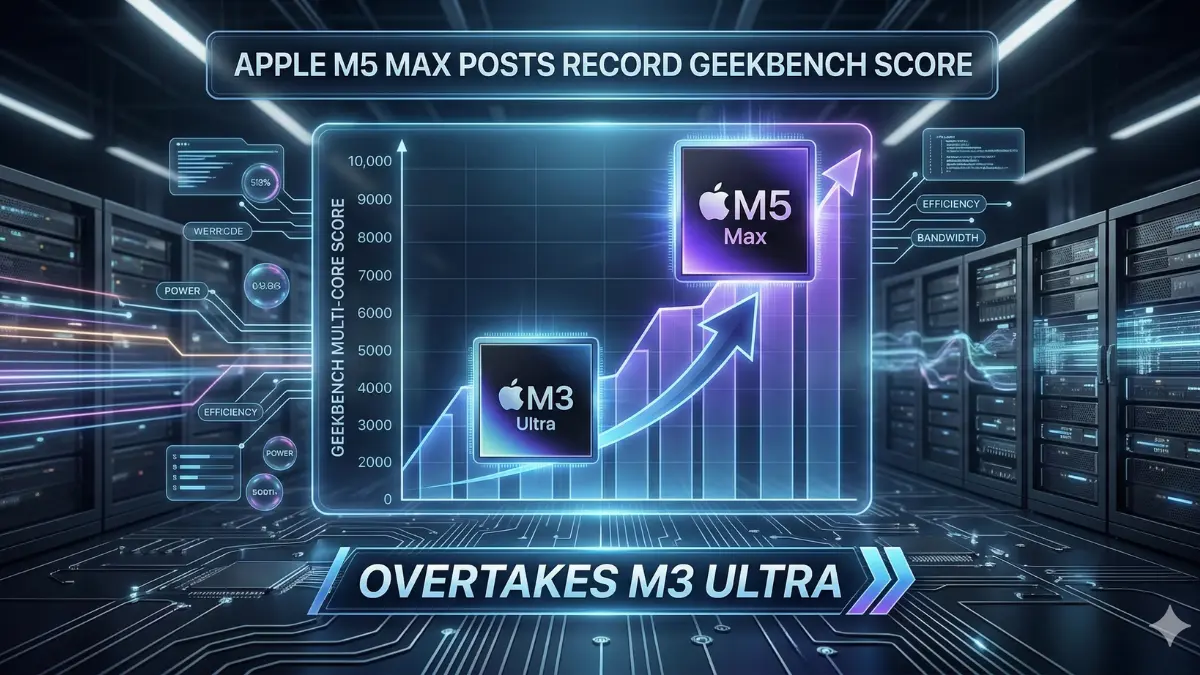
Apple M5 Max’s Multi-core performance sets a new record
In the leaked result, the 18-core M5 Max posted a multi-core Geekbench 6 score of 29,233.
That surpasses the 27,726 score achieved by the 32-core M3 Ultra inside the Mac Studio. It also places the M5 Max ahead of every other consumer PC processor currently listed in the Geekbench database.
Here’s how it compares:
| Mac Model | Multi-Core Score |
| MacBook Pro (M5 Max) | 29,233 |
| Mac Studio (M3 Ultra) | 27,726 |
| MacBook Pro (M4 Max) | 25,702 |
| MacBook Pro (M4 Pro) | 22,490 |
| Mac Studio (M2 Ultra) | 21,410 |
| MacBook Pro (M3 Max) | 20,960 |
The result suggests the M5 Max is roughly 5% faster than the M3 Ultra in multi-core workloads, despite having significantly fewer CPU cores (18 vs. 32). Compared to the 16-core M4 Max, the improvement lands in the 14–15% range.
That aligns closely with Apple’s own performance claims for the new generation.
Single-core performance pushes even higher
Single-core performance also reaches a new high.
The M5 Max recorded a single-core score of 4,268. That figure matches the standard M5 chip found in the base 14-inch MacBook Pro released in October and currently stands as the highest single-core score of any consumer PC processor in the Geekbench 6 database.
It even edges past AMD’s Ryzen 9 series in the same test.
Single-core performance is critical for responsiveness, code compilation, and many professional creative apps. A jump here often translates to noticeably snappier real-world behavior.
GPU performance climbs, but not past M3 Ultra
On the graphics side, the 40-core GPU inside the M5 Max delivered Metal scores of 218,772 and 232,718 in two separate benchmark entries.
That places it:
- Roughly 5–10% below the highest-end M3 Ultra average Metal score (245,053)
- Over 20% higher than the top-tier M4 Max average (191,600)
In other words, while the M5 Max doesn’t dethrone the M3 Ultra in raw GPU output, it closes much of the gap — and does so in a portable 16-inch MacBook Pro chassis rather than a desktop Mac Studio.
That distinction matters.
Efficiency and core scaling
The more interesting detail may be how Apple is achieving these gains.
Beating a 32-core M3 Ultra with an 18-core CPU suggests architectural improvements rather than brute-force scaling. The performance-per-core appears to have improved meaningfully, continuing Apple’s trend of aggressive year-over-year efficiency gains.
If the numbers hold, Apple is extracting more performance from fewer cores — a strategy that benefits thermals, battery life, and sustained workloads in a laptop form factor.
Still, this is a single benchmark entry. Early Geekbench listings can occasionally reflect pre-release firmware or atypical testing conditions. Broader benchmark coverage will provide a clearer picture.
What this means for buyers
For professionals using video editing suites, 3D workflows, or heavy compilation tasks, a 15% CPU uplift and 20% GPU improvement over M4 Max could be meaningful — especially for users coming from M2 or M3-class machines.
However, M4 Max owners may see this as a refinement rather than a dramatic leap.
MacBook Pro models with M5 Pro and M5 Max are available for pre-order now, with availability beginning March 11.
If these early numbers are accurate, Apple has once again reset the ceiling for consumer-class laptop silicon — this time without needing its Ultra-tier desktop chip to do it.


