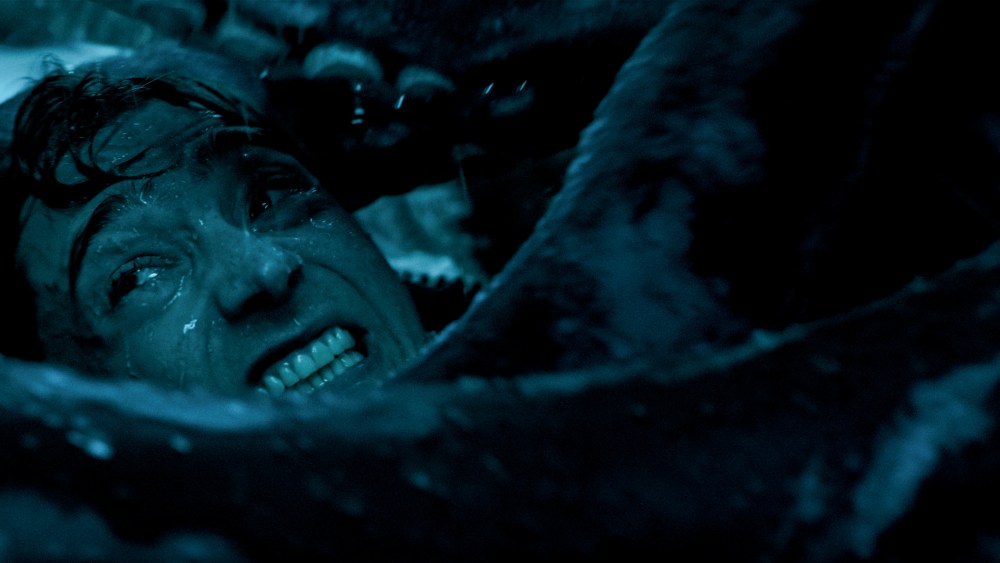
“Whalefall” director Brian Duffield is well aware that, in most cases, the main character getting swallowed by an animal would be a bit of a buzzkill.
“It would typically feel like the end of a movie,” Duffield tells Variety, cracking a wide grin. “Like, ‘RIP Austin!’”
But the team at Disney’s 20th Century Studios felt “bullish” on using the intense first 15 minutes of the adventure thriller — about a scuba diver (Austin Abrams) who, while looking for his father’s (Josh Brolin) remains, is swallowed whole by an 80-foot, 60-ton sperm whale — to tease what’s to come.
“Disney felt it’s such a crazy scene, and it happens so early in the movie, that they felt a little bullish on, ‘Yeah, let’s show them how our movie kicks off and let them wonder where we could go from there,’” Duffield says about the film’s official trailer, released on Tuesday.
“Even though we are going to be a very claustrophobic movie, we’re pretty big too!” Duffield says of the film, which debuts in theaters on Oct. 16. “We have a lot of spectacle, sometimes in surprising ways, and it just felt like we’ve never seen a movie that is set in a place where most of this movie is set.”
Choosing to center an entire film inside a sperm whale wasn’t just for a catchy log line. The filmmakers did their homework to make the hungry whale — the largest toothed predator, with the rare (and largely theoretical) power to kill by sound — look and sound as realistic as possible. Duffield studied Daniel Kraus’ 2023 book, “Whalefall,” which the film is based on, and enlisted whale experts to nail the science.
“That became an interesting thing where it’s like, ‘How do you convey that other animals in the ocean are registering that Austin is in the stomach? And what does that do to the stomach inside?’” he says. “We have different languages built in where the stomach reacts differently depending on what kind of animal is reading it.”
“Whalefall” is a thrill ride, but Duffield argues that it’s more than a straightforward monster movie. In fact, he says, “this whale is just as much a victim of Austin in this experience.”
Part of the storytelling mission is to make audiences fall in love with this animal from the inside out. “The whale is not a bad guy. The whale doesn’t understand that it’s swallowed Austin. It’s trying to swallow its lunch, and Austin is just a byproduct of that,” Duffield says. “We wanted it to not feel like a monster movie, but to feel like Austin’s inside of a living animal. There’s something horrifying about that, but also something beautiful, too.”
Austin Abrams (as Jay Gardiner) in “Whalefall.”
20th Century Studios.
All the underwater scenes were filmed in a tank built at the Radford Studio Center in Studio City, Calif.
“Everyone knew it was a very challenging set piece, and did everything they could to make it as safe, primarily, as possible, but just as visceral and exciting,” Duffield says. “When I watch it, I see everyone’s dedication to hard work.”
To that point, while there are moments in the film with a stunt double or CGI, Abrams performed most of his own stunts.
“You don’t have to push Austin to do anything to make the movie better,” Duffield says. “As soon as he was cast, he started learning how to dive, getting comfortable with all of that. It was never a conversation that we had. If anything, the only arguments we ever really got into were [when] he would want to go too far.”
That’s when he and stunt coordinator Shauna Duggins would step in and pump the brakes. “I’d be like, ‘You will die! We can’t let you do these things!’ But he was just so convicted about the same thing we were all convicted about, which is — audiences go to the movies for experiences.”

Austin Abrams (as Jay Gardiner) in “Whalefall.”
Jennifer Clasen/20th Century Studios

Josh Brolin (as Mitt Gardiner) in “Whalefall.”
20th Century Studios.
Duffield compares “Whalefall’s” claustrophobic setting to the UFO sequence in “Nope,” but says he didn’t take much inspiration from other disaster films. Most films in the genre center characters who possess some expertise that allows them to maneuver their way out of a life-or-death situation, but the fun of “Whalefall” is that the hero has no idea what he’s in for.
“Austin’s just a teenage boy. He’s really unequipped and has no training. So if anything, we talked, ‘Well, these things are happening. You should just be screaming!’” Duffield says. “There’s no pretense or ‘the training kicks in’ kind of thing. Once you realize where you are, you just lose your shit, melt down and start crying like a baby.”
“Whalefall,” which hits theaters on Oct. 16, will be shown in 4DX, which features motion-enabled chairs, sensations and smells. The film is still deep in post-production, so the exact experience is still being designed, and the filmmaker is excited to see how the immersive theatrical experience will make being inside a sperm whale even more terrifying.
“I’m literally learning more about it in six hours,” Duffield says. “I’m really curious to see how much more anxiety that gives the process because even just the motion of the whale swimming casually is going to add a lot of terror. You’re constantly reminded that you’re inside of a living god, essentially.”
Watch the trailer below.


