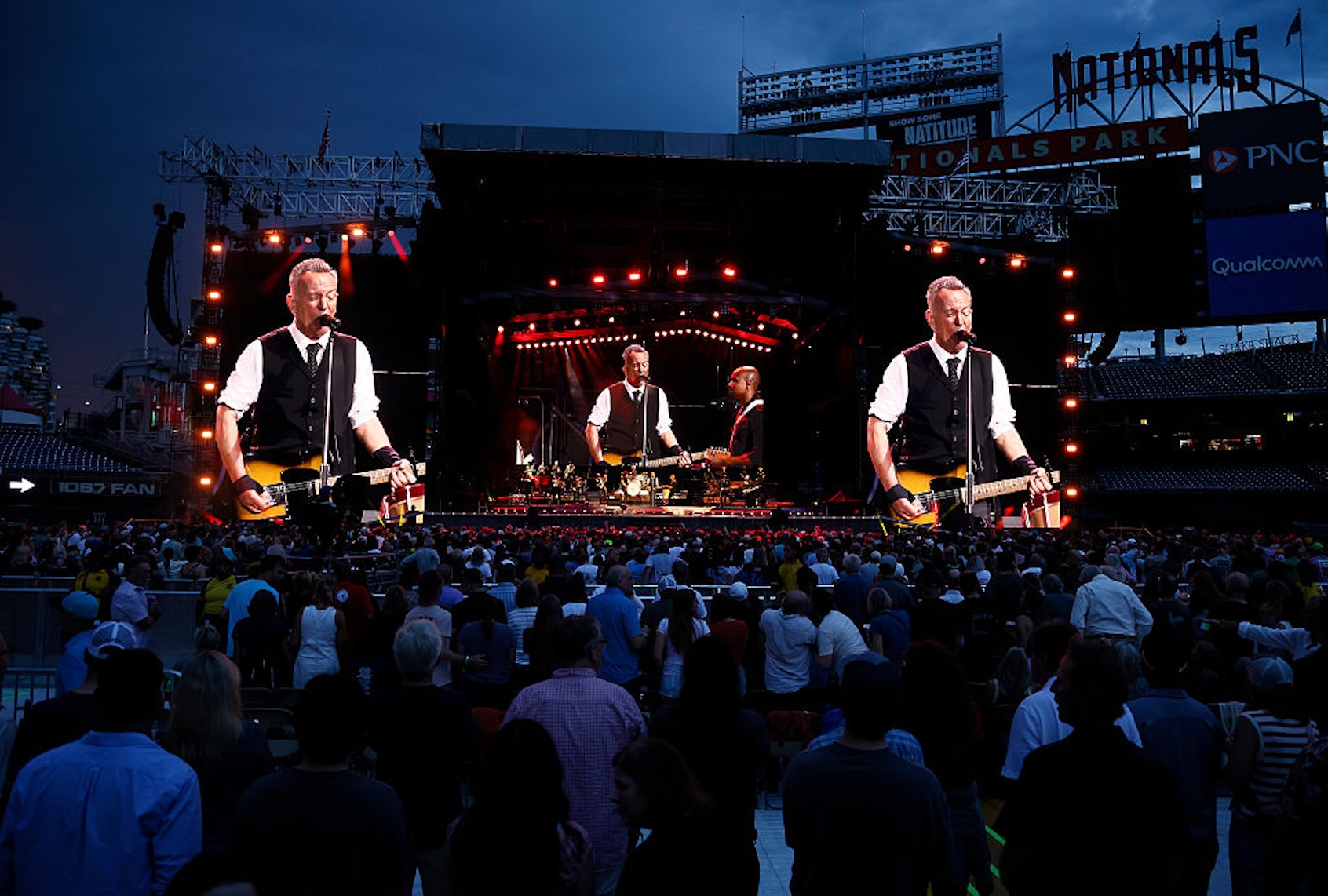
After dealing with Donald Trump for the better part of the last decade, it was not until Wednesday night that I finally understood the difference between my childhood and today. I credit Bruce Springsteen and the E Street Band for making that distinction clear.
Springsteen rode into Washington, D.C., to play in the driving rain for 40,000 fans at Nationals Park with the energy of a 19-year-old — and the insight of a 76-year-old who lived through the same divisiveness I experienced as a child. His performance, according to Nils Lofgren, one of the guitarists in the 19-piece E Street Band, was a “brutally honest and melodic statement of Truth.”
To say that things have dramatically changed in the United States since I was a child in the 1960s is an understatement. It’s not the gaping hole in the ground that used to be the White House’s East Wing – which gives the unpleasant impression the executive mansion is rebuilding from a bombing. It’s not the circus-like cage arena currently being built on the South Lawn for an upcoming UFC event. It’s not the convicted felon who is our president, nor his proposed slush fund for those who participated in the Jan. 6 insurrection. It’s not the wars in Iran or Ukraine, nor is it the lazy malfeasance dominating Congress. It isn’t even the daily acts of revenge Trump enacts against James Comey, E. Jean Carroll or any of his other imagined enemies. It’s not the multiple assassination attempts.
Twice in a span of 17 days in 1975, someone tried to kill President Gerald Ford – one of them was a woman named “Squeaky” who ran around with Charles Manson, the infamous mastermind of two politically motivated mass murders. Richard Nixon, while not convicted, was every bit the criminal Trump shows himself to be. The Vietnam War dominated the headlines every day for years. I remember multiple assassinations of politicians and moral leaders, and the Kent State massacre, when the National Guard fired on a group of unarmed college students protesting the Vietnam war.
And therein lies the difference I can quantify. When Crosby, Stills, Nash and Young sang “four dead in Ohio,” our neighbor, a Nixon fan, decried the group as a bunch of “Commie hippies” out to destroy the United States. The oldest son in that family, a similarly minded conservative, disagreed with the song, but he still loved the group. Music was a common thread in all of our lives. When Edwin Starr sang “War,” we all knew it was worth absolutely nothing — even those who supported war felt that. There’s little like that being sung today.
On Tuesday, I found myself wandering the halls of Congress. The House wasn’t in session, which is often the best time to check in on staff who don’t have their overlords hanging around. I was particularly curious about the members of Congress who have adorned the walls outside their offices with posters proclaiming their appreciation for the Capitol Police and law enforcement in general. “Back the Blue” and “Defend Police” signs hang alongside Charlie Kirk banners much like the posters you’d see in high school student council races. My question was simple: Did those who proclaim their love for police support Trump’s proposed slush fund for the insurrectionists who either pleaded guilty or were convicted by a jury of their peers for assaulting police and the Capitol on Jan. 6?
No staffer, of course, would comment. One said, with disdain, “Whatever the president is for, is what we’re for.”
No staffer, of course, would comment. One said, with disdain, “Whatever the president is for, is what we’re for.”
When I reminded them that Texas Sen. John Cornyn and Kentucky Rep. Thomas Massie — both of whom were recently defeated in their respective primaries by opponents endorsed by the president — voted with Trump more than 90% of the time, they just sighed. “Look what that got them,” I said. No one had an answer.
In one office I overheard a press secretary and a chief of staff talking about music. “Springsteen is in town Wednesday, are you going?” one of them asked.
“I can’t like him anymore,” the other replied. “He’s got TDS.”
Both nodded at the mention of Trump Derangement Syndrome and quietly sighed.
They think that even if they like someone’s music they cannot admit it — because their president doesn’t like it. That is the difference between yesterday and today. We’re losing our independence not from force, but by acquiescence.
Young reporters who stood in line with me to get their press passes renewed in a nearby Senate office were the reportorial equivalent of their congressional staff counterparts. I stood quietly listening to them talk about what they should wear, the best places to eat and how “overwhelmingly jazzed” they were to be in the Capitol. One of them said, with awe, they’d even spotted a member of Congress recently. Another young reporter, describing themselves as a “supervisor,” spoke with their staff about the best nearby coffee spot — and the best shoes to wear while walking through the Capitol and congressional offices. There was no talk about holding powerful people accountable for their actions. It was the mind-numbing talk of people eager to go along to get along.
The banter became raucous enough that a staffer had to step out into the hall and tell them to quiet down. “People are working in the adjacent offices,” he said.
The group quieted down like scandalized school children. “Mean,” one of them said. Another was busy holding up their phone and described to an audience of close friends and followers what was going on. Inside the office, another veteran reporter, waiting to get their picture taken for their press pass, said to no one in particular, “I don’t know if I’m more upset because they were talking about nothing or because they got quiet so quickly.”
Another, sitting next to me, was equally sanguine. “They just have no idea why we’re here.”
Want more sharp takes on politics? Sign up for our free newsletter, Standing Room Only, written by Amanda Marcotte, now also a weekly show on YouTube or wherever you get your podcasts.
Reporters serving as fans in Congress, rather than speaking truth to that power, may be the way of the future as Trump recently proposed forcing federal workers to sign nondisclosure agreements. This means the president wants federal employees who work for the American people to no longer be responsible to us, the public — just to him. You do not have permission to like anyone but him. That action, combined with the ignorance of young reporters, will kill the Fourth Estate.
Democracy ended. Game over.
For now, among those who remain cogent, it’s all “survival mode,” as a Republican congressman told me. “We’ve been speaking about the president’s danger privately, but we need to speak out publicly,” he said — privately.
Those who are now on the outside, like Cornyn and Massie, will be carrying the water for those in the GOP who have grown to loathe the president they once loved, instead of carrying water for Trump. The next six months are primed to be the end of Trump’s overwhelming influence over Congress. Those like Cornyn and Massie, who supported Trump and have been abandoned and replaced, can certainly make a mess for the president and his agenda before they leave. Meanwhile, there’s no guarantee that candidates who won the Republican primaries with Trump’s help can win a general election. The president is counting on his word to guarantee continued success — no matter how depraved the party continues to become under his watch. Who will help?
The press has failed. Congress has failed, and while some in the GOP may be experiencing “buyer’s remorse” with their decision to back Trump — Megyn Kelly’s recent admission about Trump’s corruption comes to mind — the divisive nature of our culture has kept anyone from capturing the national zeitgeist of revulsion many share about Trump.
That’s where the “righteousness of rock n’ roll,” as Springsteen described it Wednesday, comes into play. He is following the spirit of social awareness from the music of my youth, as well as his own musical past. “Born in the U.S.A.” is as haunting today to listen to as it was when he first sang it in 1984.
“Bruce thought it was important to say something, to do something,” Lofgren said. Four times during the course of a nearly three-hour set of 27 songs — that included gospel, rock and Woody Guthrie-inspired American folk music — Springsteen stopped the show and spoke directly to the audience.
“If you’re feeling helpless, if you’re feeling hopeless, if you’re feeling betrayed, if you’re feeling frustrated, if you’re feeling angry, I understand,” Springsteen said. “That’s why we’re here tonight.”
“If you’re feeling helpless, if you’re feeling hopeless, if you’re feeling betrayed, if you’re feeling frustrated, if you’re feeling angry, I understand,” he said. “That’s why we’re here tonight.”
“You could hear a pin drop,” Lofgren explained later.
“We needed to come to Washington and feel your strength and your hope and your faith,” Springsteen continued onstage. “We needed to bring to your city some strength and some hope and some faith.”
He talked about the darkening American dream, the mental pain of being distanced from neighbors, a corrupt Justice Department and how Trump has trashed the American ideal to protect his rich and powerful friends. If Woody Guthrie were alive today, he would have joined Springsteen. (After the show ended, concertgoers left the stadium to the sounds of Guthrie singing “This Land Is Your Land.”)
Backstage, he talked about the need to “Say something. Do something. Sing Something. Hell, that’s what I do.” He has said that so often that some concertgoers have it printed on a T-shirt.
Donald Trump didn’t divide us. We were already divided because of the internet, a failing media infrastructure and corporate greed. Trump just bottled and sold the divide, and capitalized on it to his benefit.
Some of his own supporters may have started to see him for what he is, but the 40,000 plus people who filed into Nats Park took it a step further. Springsteen yelled for the crowd to sing their hardest so they could be heard at the White House several blocks away. They did. The E Street Band rose to the occasion with an unbelievable amount of energy.
For the first time in a long time, it felt just like the time of civil unrest of my youth.
Springsteen began the night talking about the disintegration of voting rights, the rise of hatred and a war in Iran that seems to have no end in sight. Then he broke into Edwin Starr’s anthem, singing loudly: “War, what is it good for?”
I got goose pimples on my arms. With that song I suddenly flashed back to Nixon’s resignation. For the first time since Trump became president — as the rain poured down, as the fans cheered and Springsteen sang — I thought Trump just might be at the end of his leash.
After the gig, members of the E Street Band gathered to celebrate at a local hotel bar. I had the opportunity to attend as well. Some, like Lofgren, are as old as Springsteen, but many of them were never around for the Vietnam War. I marveled at their energy, which seemed to feed off the audience and then infuse it with even more power. “Bruce is a unicorn,” they said, praising his dynamic performance. But could any of it make a difference?
“Well, I certainly hope we make Trump miserable enough to leave,” several of them said.
I smiled.
That would certainly be nice.
Read more
about Donald Trump


