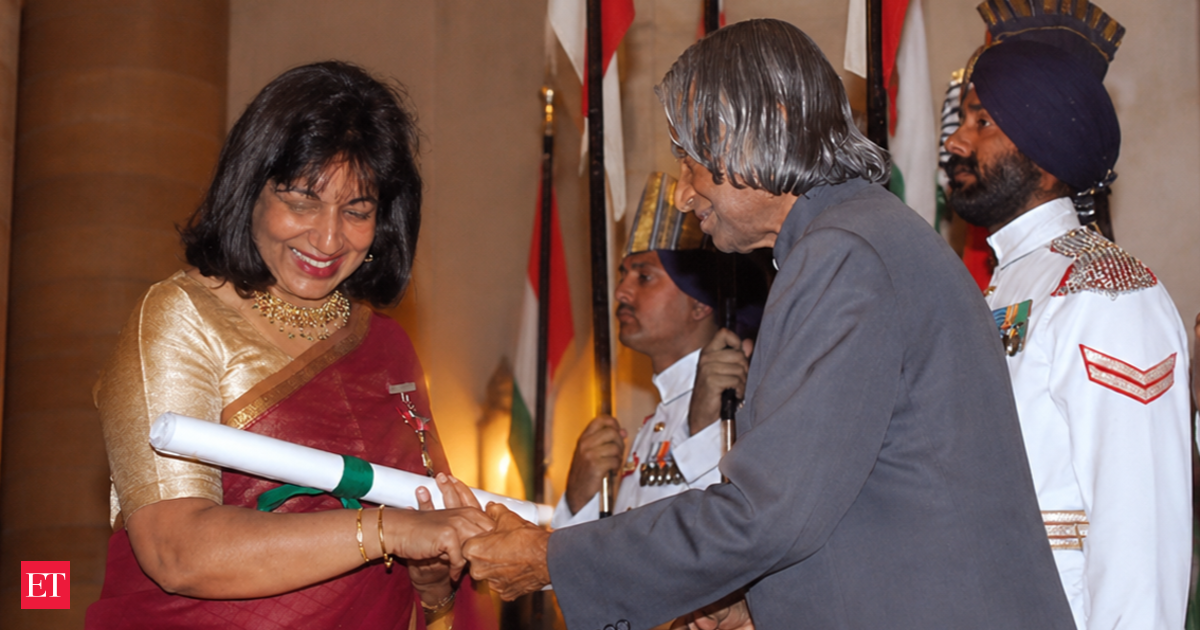
Also Read: Biocon’s Kiran Mazumdar-Shaw chooses niece Claire Mazumdar as successor
By choosing a successor with deep roots in oncology and a proven track record in the NASDAQ ecosystem, Mazumdar-Shaw is ensuring that the empire she built from a garage remains anchored in radical innovation rather than mere corporate maintenance. The transition would be gradual as she said she is “not planning to hang up my boots for a while” and Claire would “gradually transition into my role in time.” So there will be continuity in leadership even as succession plans take shape.
This passing on the baton marks the culmination of a decades-long journey characterised by an unrelenting defiance of the business norms of the day.
The fermentation of a rebel’s ambition
The foundational years of Kiran Mazumdar-Shaw’s career make for a narrative of institutional rejection followed by individual triumph. Her journey began not in a boardroom, but in the malting sheds of Ballarat, Australia, where she was the only woman in her brewing class, a discipline her father, a chief brewmaster, had inspired her to pursue. When she returned to India in 1975, armed with a world-class education in fermentation science, she was met with a wall of disbelief. The Indian brewing industry of the mid-70s was a closed fraternity that viewed a woman in a production role as a liability rather than an asset. She was repeatedly told that a woman cannot manage a brewery, a rejection that left her qualified but unemployed in her chosen field.

Kiran Mazumdar-Shaw in a business meeting with a Papain supplier in 1979
Image Courtesy: Biocon website
This forced career pivot was the genesis of Biocon. Rather than retreating, she channeled her expertise in enzymes — the biological catalysts used in brewing — into an entrepreneurial venture. In 1978, a serendipitous meeting with Leslie Auchincloss, the founder of Biocon Ireland, led to the formation of Biocon India as a joint venture. However, the partnership was merely a legal framework. The operational reality was a gruelling struggle for legitimacy. With only Rs 10,000 in seed capital and a rented garage in Bangalore, she faced a triple handicap — she was a young woman, she was operating in a high-risk technology sector that bankers didn’t understand, and she had no business background. Her early story is of radical bootstrapping, where she served as the lead scientist, the marketing head, and the administrative clerk all at once.
Also Read: A silent force behind a $1.6 billion firm may write Biocon’s future scripts
Kiran Mazumdar-Shaw at the Biocon building site in early 1980s
Image Courtesy: Biocon website
Orchestrating the great strategic pivot
The second phase of her business journey involved a calculated shift from industrial enzymes to the high-stakes world of biopharmaceuticals, a strategic masterstroke of her career. By the late 1980s, Biocon had become a successful manufacturer of enzymes like papain (derived from papaya) and isinglass for the food and beverage sectors. However, Mazumdar-Shaw realised that bigger scope lay in the human health sector. This transition was technologically daunting. It meant moving from simple fermentation to the complex world of recombinant DNA technology and molecular biology.
This era saw the birth of Syngene International in 1994, a visionary move to monetise the brainpower of Indian scientists. By offering contract research services to global pharmaceutical giants like Bristol-Myers Squibb, Biocon created a self-sustaining ecosystem that funded its own internal drug development. This dual-model approach allowed her to insulate the company from the all-or-nothing risks typical of biotech startups. The pivotal moment arrived in 2001 when Biocon became the first Indian company to gain USFDA approval for the manufacture of Lovastatin, a cholesterol-lowering drug. This validation from the world’s most stringent regulator transformed Biocon from a local player into a credible global entity, setting the stage for its blockbuster IPO in 2004.
Kiran Mazumdar-Shaw at the inauguration of Syngene in 1994
Image Courtesy: Biocon website
Scaling the biosimilars mountain
The most recent decade of Mazumdar-Shaw’s leadership has been focused on the biosimilars frontier — the biological equivalent of generic drugs. Unlike simple chemical generics, biosimilars are grown in living cells and are incredibly difficult to replicate, requiring massive R&D investments and sophisticated manufacturing facilities. Her strategy was to disrupt the global insulin and oncology markets by offering high-quality alternatives at a fraction of the cost. This mission was punctuated by landmark approvals, including the 2017 USFDA approval for Ogivri, a biosimilar for the breast cancer drug Herceptin, marking a first for any company globally.
Her business journey in this phase has been one of global scale and vertical integration. The acquisition of Viatris’ global biosimilars business for over $3 billion in 2022-2023 was the ultimate consolidation move, giving Biocon direct commercial footprints in the US and Europe. While this massive expansion has led to temporary financial consolidation, with recent net profits being squeezed by high debt servicing and persistent R&D spending, the underlying infrastructure now places Biocon among the top five biosimilar players in the world. This is no longer a garage startup but a sprawling multi-national with over 15,000 employees and a product reach spanning 120 countries.
The vision ahead
Today, Biocon is a complex conglomerate of three major pillars: the generics and biosimilars business (Biocon Biologics), the contract research arm (Syngene), and the novel biologics division. The company’s current market capitalisation of approximately Rs 60,000 crore reflects its status as a bellwether for Indian biotech. Recent financial filings indicate a revenue trajectory that is consistently climbing, with the biosimilars segment now contributing more than 50% of the group’s total earnings. The strategic focus has moved toward “Biocon 5.0,” which emphasises digital transformation, artificial intelligence in drug discovery and a deeper penetration into the specialty medicines market in North America.
The induction of Claire Mazumdar as the chosen successor is the final piece of this evolutionary design. Claire’s background in high-tech oncology and her experience in the American capital markets align perfectly with Biocon’s current needs. As the company navigates a world of tightening regulatory standards and intense global competition, the transition ensures that the science-first culture instilled by the founder will be preserved.
Mazumdar-Shaw has spent nearly five decades proving that an Indian woman could build a world-class science company. By passing the baton to a scientist-entrepreneur like Claire, she is ensuring that the story she started in a Bangalore garage continues to redefine global healthcare for the next generation.


